Olympia
Olympia is the beautiful, silent daughter of Professor Spalanzani who is revealed to be a lifeless automaton, and whose uncanny presence drives Nathaniel into madness and ultimately to his death. She embodies the terrifying fusion of the ideal beloved and the mechanical object, a figure whose blank perfection seduces Nathaniel into abandoning reality and whose violent unmasking shatters his sanity.
Identity and First Appearance
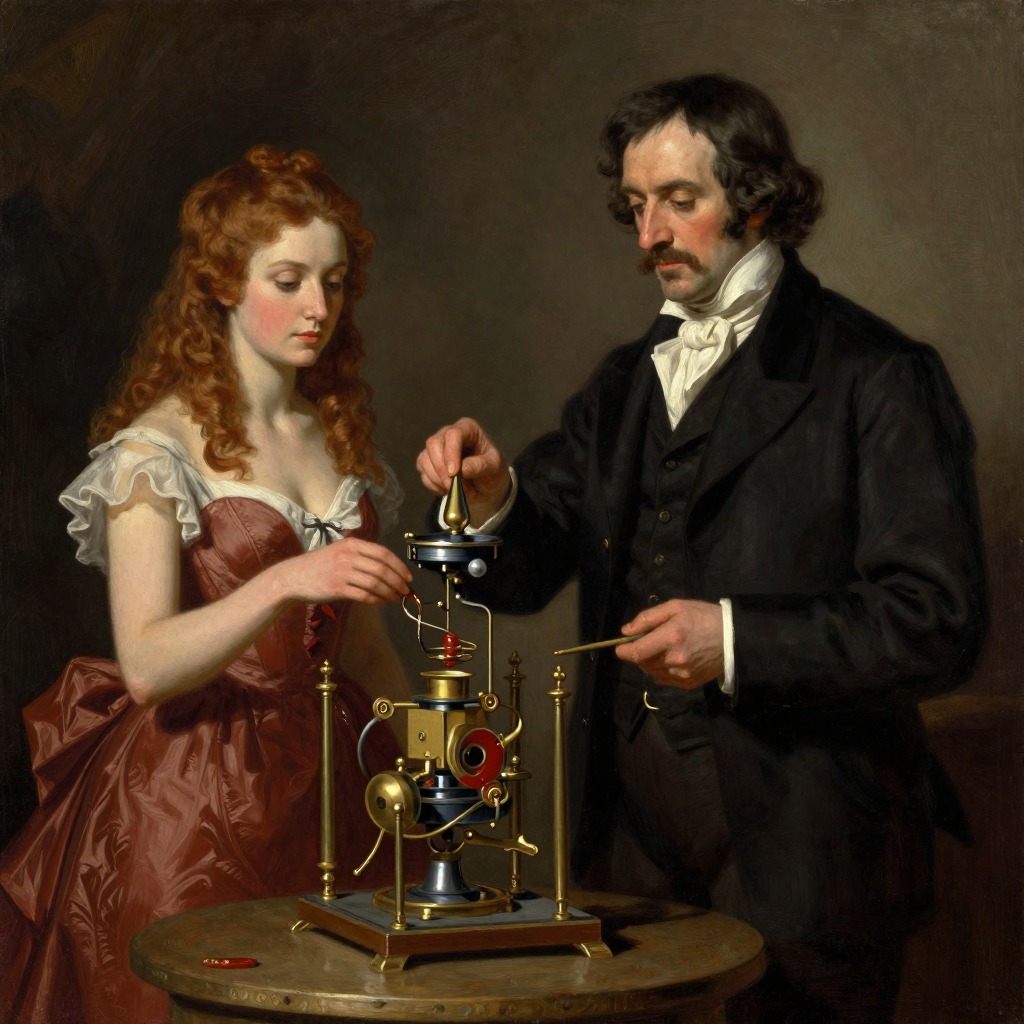
Olympia first appears to Nathaniel as a vision glimpsed through a crack in a curtained glass door. He sees a tall, very slender and well-proportioned, splendidly dressed lady seated at a little table, her hands folded before her. Her face strikes him as angelically lovely, but her eyes have something glassy about them, as if she slept with open eyes. He later learns that Spalanzani keeps her locked up so that no one can come near her, and he begins to suspect she may be simple-minded. After a fire destroys his apartment, Nathaniel moves into a room directly opposite Spalanzani's house and from his window can peer into the room where Olympia often sits alone, positioned in such a way that he can clearly recognize her figure while her facial features remain blurred and vague. He notices that she often sits for hours on end in the same stance, perched before a small table, apparently engaged in no activity, and that she casts a fixed gaze in his direction. He admits to himself that he has never set eyes on a lovelier female figure, but, holding true to Clara in his heart, he remains largely oblivious to Olympia's stiff, stone-cold allures, only casting furtive looks at the comely statue.
Transformation Through the Looking-Glass
Nathaniel's perception of Olympia changes radically when he purchases a small, finely crafted pocket looking-glass from the optician Coppola. Peering through it into Spalanzani's room, he sees Olympia's exquisitely lovely face with unprecedented clarity. Only the eyes appear strange, blank and dead, but as he brings her face into greater focus, it seems to him as if Olympia's eyes flash open in moist moonbeams, as if she had only now acquired the power of sight, her glances growing livelier and livelier. He lingers at the window, transfixed, unable to take his eyes off her. The next day the curtain is pulled shut in that fateful room, and he cannot catch sight of her for three days, despite seldom leaving his own window and constantly peering over with Coppola's looking-glass. On the third day even the blinds are pulled. Desperately pining and driven by a burning desire, he runs out to her front door; impressions of Olympia's lovely figure hang in the air everywhere he looks, and Clara's image is totally erased from his heart.
Spalanzani's Party and the Dance
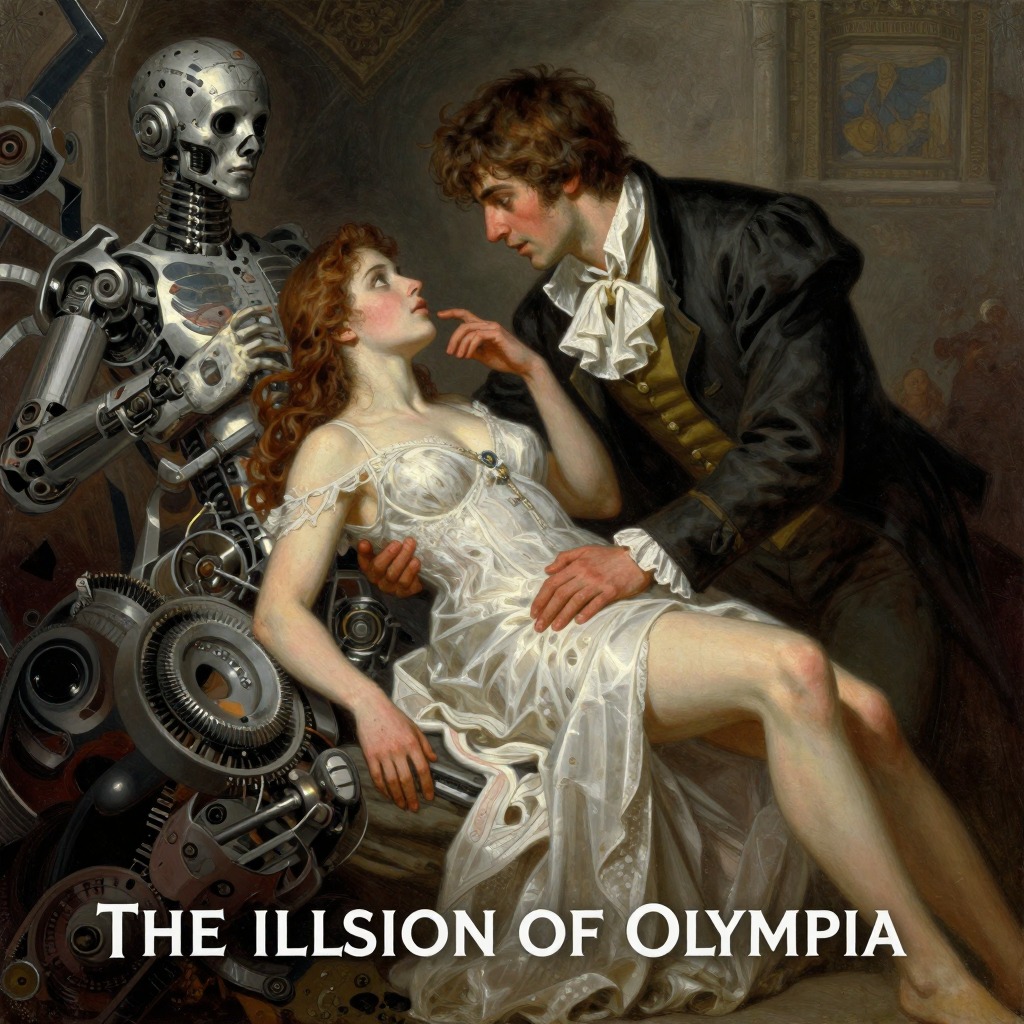
Spalanzani throws a big party including a concert and ball, and Olympia appears for the first time in public, richly and tastefully attired. Everyone admires her finely chiselled face and graceful figure, though some find displeasing the measured stiffness in her stance and step, which is ascribed to the stress of appearing in society. Olympia plays the grand piano with great skill and brings off a bravura aria with a clear, almost bell-glass-like, pitch-perfect voice. Nathaniel, standing in the last row, pulls out Coppola's looking-glass and gazes through it at her; he now fathoms how ardently she peers in his direction, how every note seems to sound enveloped in a loving look that surges through his burning heart. The artful trills ring in his ear like heavenly Hosannas, and when the long trill pierces the air, feeling as though suddenly enveloped by her warm embrace, he cries out in rapture and pain: "Olympia!" When the ball begins, he finds himself standing right beside her, reaches for her hand, and feels it is ice-cold, a terrible deathly frost surging through him. He looks into her eyes, which greet his gaze with love and longing, and at that very moment it is as if the pulse begins to beat in her cold hand and the lifeblood begins to glow warm within. He wraps his arm around her and leads her down the rows of dancers, though her precise rhythmic steadiness often causes him to falter. He no longer wants to dance with any other woman and feels he would kill anyone else who dared approach her. Olympia always remains seated between dances, and he does not hesitate to pull her up again and again. Fired up by the dance and wine, he sits beside her, his hand in hers, speaking fervently of his love in words that neither he nor she understands. She peers without flinching into his eyes and sighs again and again: "Oh – Oh – Oh!" He replies with declarations of love, and she keeps sighing the same "Oh, Oh!" When the last lights burn down, he kisses her hand and leans forward to kiss her on the mouth; her lips are ice-cold, and he feels a shudder, the legend of the dead bride suddenly flashing through his mind. But Olympia presses him tightly to her, and in that kiss her lips seem to come alive with warmth. He whispers, "Do you love me – do you love me, Olympia? Just that one word! Do you love me?" Standing up, she only sighs: "Oh! Oh!" Spalanzani, smiling with satisfaction, invites Nathaniel to visit whenever he likes.
The Courtship of a Silent Listener
Nathaniel completely forgets Clara, his mother, Lothar, everyone; he lives only for Olympia, sitting beside her for hours every day, holding forth on his love, on a life flushed with sympathy, on their psychic affinity. From the depths of his desk drawers he fetches everything he has ever written—poems, fantasies, visions, novels, stories, and daily high-flown sonnets, stanzas, canzone—and tirelessly reads them to Olympia for hours on end. He has never had such a lovely listener: she does not embroider or knit, does not peer out of the window, feeds no birds, plays with no lapdogs or cuddly cats, holds back no furtive yawns; for hours and hours she peers with a fixed and steady gaze into the eye of her beloved without fidgeting or budging, and her gaze grows ever livelier and more intense. Only when Nathaniel stands up and kisses her on the hand, and even on the mouth, does she respond: "Oh, oh!" followed by "Good night, my dear!" Nathaniel experiences inner bliss, pondering the wondrous harmony that manifests itself ever more each day between his and Olympia's spirits; it seems to him as if Olympia has grasped his works, his poetic gift, from the depths of her soul, indeed that her voice comes from the bottom of her innermost self. When at his most lucid moments he ponders her total passivity and laconic manner, he shrugs it off: "What are words – words! Her heavenly gaze says more than any hollow language." Spalanzani seems delighted by the relationship and gives unequivocal signs of approval; when Nathaniel alludes to a future bond with Olympia, Spalanzani replies that he will leave it to his daughter to decide of her own free will. Emboldened, Nathaniel decides to implore Olympia the very next day to declare clearly in plain words that she wishes to be his for evermore. He searches for the ring his mother gave him, finds it, stuffs it in his pocket, and runs over to see her.
The Revelation and Destruction
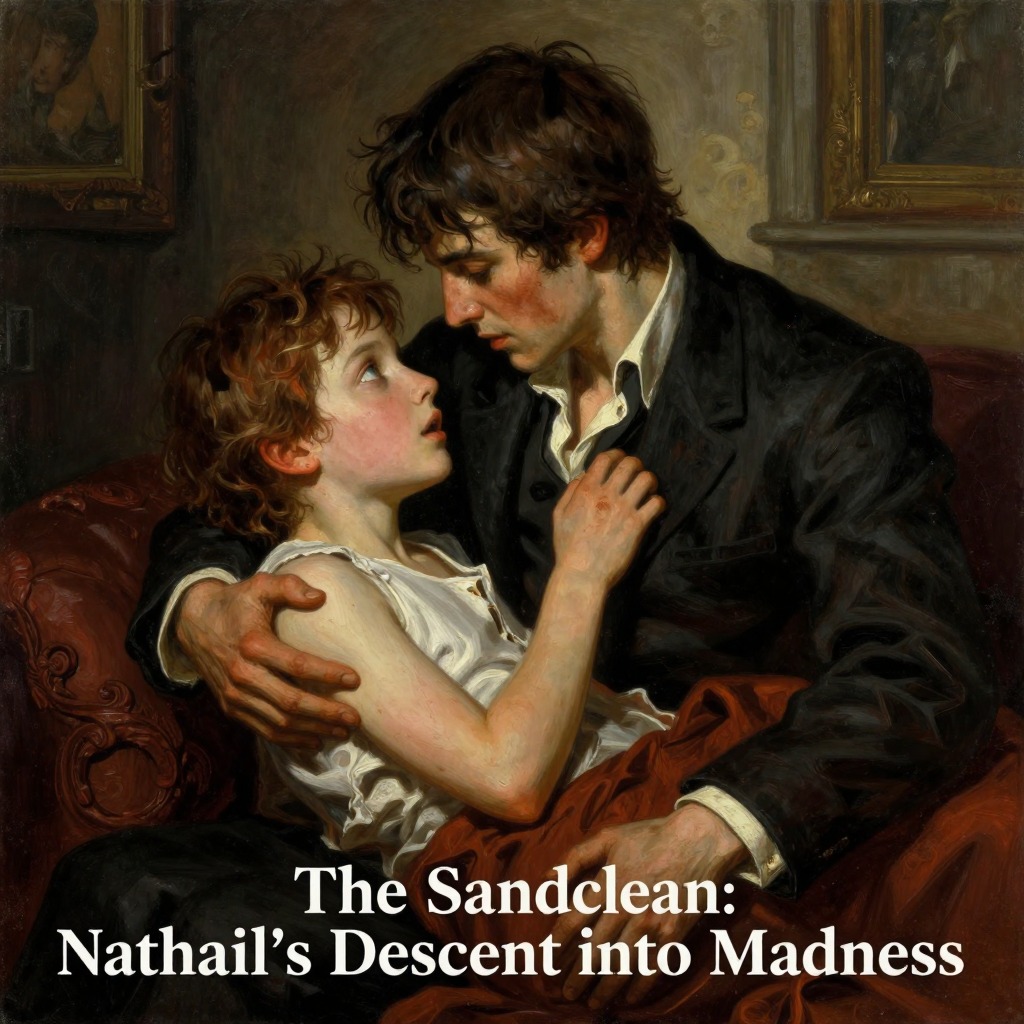
From the doorstep and vestibule, Nathaniel hears a strange din emanating from Spalanzani's study: stamping, clattering, shoving, pounding on the door, interspersed with coarse words and hurled imprecations. The voices of Spalanzani and that disgusting Coppelius screech and rage. Nathaniel bursts in, gripped by unspeakable terror. The Professor holds a female figure by the shoulders, the Italian Coppola holds her by the feet; they tug and tear her here and there, furiously fighting for possession. Nathaniel recoils in profound horror when he recognizes the figure as Olympia; flaring up in a wild fit of anger, he is about to tear his beloved out of their struggling grip, but at that very moment Coppola manages to yank the figure free and, swinging her in his direction, lands Nathaniel such a stunning blow that he tumbles backwards over the work table, toppling and knocking down phials, retorts, bottles and measuring glasses, all of which smash in a thousand pieces on the floor. Then Coppola flings the figure over his shoulder and races with a repulsive, shrill laugh down the steps, so that the ugly dangling feet of the figure bang with a wooden thud and thump on the steps. Nathaniel sees all too clearly that Olympia's deathly pallid wax face has no eyes, but black hollows in their stead; she is a lifeless doll. Spalanzani, thrashing on the floor with glass shards cutting his head, chest and arms, blood spurting as though from a fountain, pulls himself together and cries out: "After him – after him – why do you waver? Coppelius – Coppelius has robbed me of my finest automaton – twenty years' work – life and limb invested – the clockwork – speech – step – all mine – the eyes – the eyes robbed from you. Cursed hellhound! After him – fetch me back Olympia – there are her eyes!" Then Nathaniel spots a pair of bloody eyes peering at him from the floor. Spalanzani grasps them with his uninjured hand and flings them at him so that they strike him on the breast. Then madness grabs Nathaniel with its burning claws and bores its way into his heart of hearts, tearing his thinking and feeling to shreds. He flings himself at the Professor and would have strangled him, but many people storm in, tear the raging Nathaniel from the Professor's neck, and save the old man's life. Nathaniel, kept screaming in a terrifying voice, is overpowered, flung to the floor, tied up, and taken to the madhouse.
Aftermath and Legacy
Spalanzani completely recuperates from his wounds but is forced to leave the university, as Nathaniel's story stirs up a public uproar and it is commonly held to be an altogether fraudulent swindle to try to pass off a wooden doll for a living person in proper society. Jurists go so far as to call it a refined, and therefore all the harder to punish, swindle. The story of the automaton takes root, and a dreadful distrust of human figures seeps into people's souls. In order to be completely convinced that they are not in love with a wooden doll, quite a few lovers demand that their beloved sing something off-key and dance out of step, that they embroider and knit while being read to, and above all that they not just listen but also occasionally say something in such a way as to demonstrate that their words necessarily derive from actual thought and feeling. Consequently the loving bond of many couples grows stronger and all the more attractive, but others quietly drift apart. Yawning becomes all the rage at social teas, but people refrain from sneezing, so as to dispel any suspicions. Spalanzani is obliged to leave the town to escape the criminal investigation into his fraudulent introduction of an automaton into human society. Coppola also vanishes. Olympia, the automaton, is never seen again, but her legacy—the terrifying possibility that the beloved might be a soulless machine—lingers in the social imagination, a permanent crack in the trust that binds human intimacy.